
Strength after 60: two days a week is enough
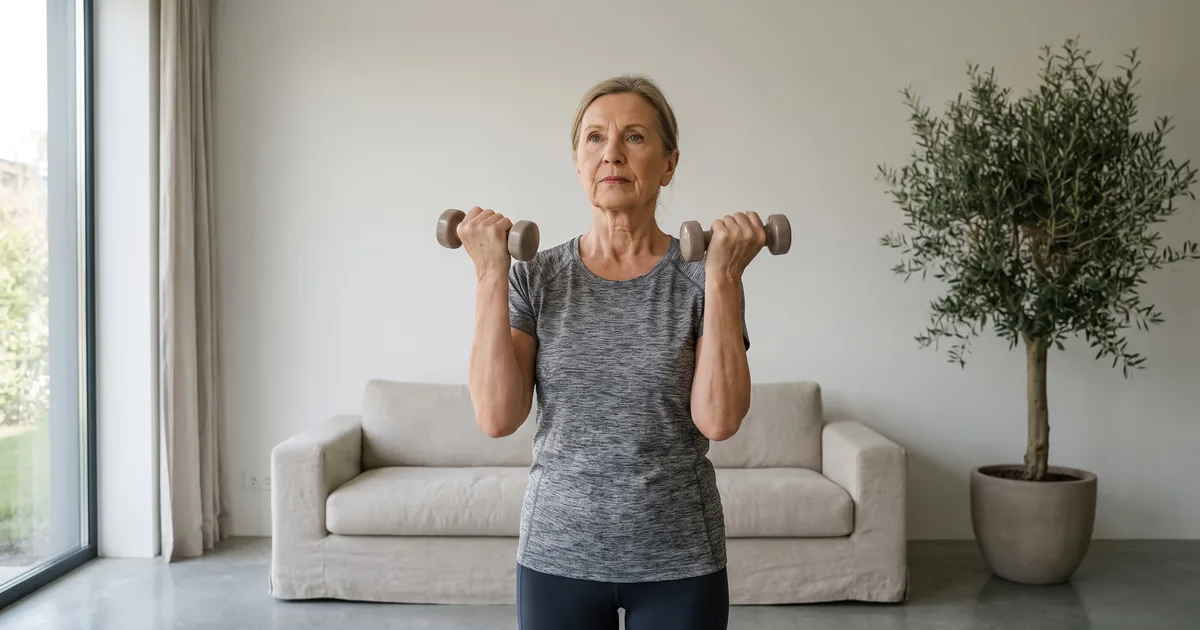
A meta-analysis went looking for the minimum effective dose of strength training for older adults with sarcopenia, and it was surprisingly small. Here is the full routine, sets and reps included.
If you have turned 60 and somebody has told you that keeping your strength means moving into the gym, we have good news: a recent meta-analysis went looking for the minimum dose that genuinely works, and it turned out to be surprisingly small. Two days a week. No early starts, no five sessions, no lifting like a docker.
What was actually measured
The paper, published in BMC Geriatrics, pools 12 randomised trials with 538 older participants with sarcopenia, the loss of muscle mass and function that comes with the years, and compares different doses of resistance training. The result: two sessions a week at moderate intensity, with 2-3 sets of around 10 repetitions, were enough to improve grip strength and physical performance as measured by the SPPB battery, the one that scores rising from a chair, walking and holding your balance. Training on more days added no further benefit.
One finding is worth reading slowly: muscle mass did not change significantly. That sounds like failure and it is not. What improved was exactly what you use every day: the strength to open a jar, the stability not to wobble when you turn, the ability to get off the sofa without pushing up with your arms. The mirror is a terrible judge of this.
And one detail makes a real difference: including pulling exercises, as opposed to only pushing ones, significantly improved the results. That is precisely what is missing from most home routines, which are heavy on press-ups and light on rows.
Your session, exercise by exercise
Here is a concrete plan built from those numbers: two sessions a week on non-consecutive days, Tuesday and Friday work beautifully, 2-3 sets of 10 repetitions per exercise and a minute or two of rest between sets. Moderate intensity means finishing the set still able to do two or three more repetitions, not grinding to failure and watching your life flash by.
The full session, about 30 minutes
- Sit-to-stand squat: lower under control, brush the seat and stand up. 2-3 sets of 10.
- Row with a resistance band anchored to a door: the pull, the star of the study. 2-3 sets of 10.
- Dumbbell chest press, or press-ups with your hands on the kitchen worktop. 2-3 sets of 10.
- Band pulldown from above: the second pull, and the one that looks after your back. 2-3 sets of 10.
- Glute bridge, lying on your back with your feet planted. 2-3 sets of 10.
- Calf raise holding the back of a chair. 2-3 sets of 12.
- Step up and down onto a step, alternating legs. 2 sets of 10 per side.
Kit: a pair of light dumbbells or two water bottles, a cheap resistance band and a chair that does not slide. That is all. Before the first set, spend five minutes warming up properly; the RAMP method is the most sensible way to do it without taking all morning. And if you would rather learn the movements before adding weight, a home strength routine with no equipment is a good stepping stone.
One note that is not mere politeness: if you have a joint replacement, an unresolved injury or a cardiovascular condition, run this plan past your doctor or physiotherapist before you start. The right dose for you may be a different one, and finding out costs a single appointment.
How to tell whether the intensity is right
No percentages, no calculators. If at the end of those 10 repetitions you could have done two or three more with good form, you are on track. If you reach the eighth shaking, with your back doing odd things, you have gone past moderate. And if you finish the 10 without noticing, add a little weight next week. Progress is precisely that: the same thing again with slightly more.
The goal is not the scales or the mirror: it is still carrying your own shopping home at eighty.
The Victoris team
Start this week
Two days. Half an hour. Eight weeks before you notice the chair lets you go without a fight. It is the best return on investment we know of, and there is no version of this that starts next Monday: the first session can be today, at half intensity, using the kitchen chair.
And because strength works better with company, add some walking. If you fancy those walks counting towards something without any deadline hanging over them, the Victoris Infinite Challenge never expires: you add kilometres when you can, with no race against the calendar.
Turn those kilometres
into a medal.
Sign up for a Victoris challenge and every training session brings you closer to the medal delivered to your door.
More from the Victoris Diary
 Entrenamiento
Cycling to work: the workout that does not eat into your diary
To coincide with European Mobility Week, we look at what the research says about riding to the office, what you gain and how to start safely without arriving drenched at your first meeting.
 Entrenamiento
The five components of fitness (and the one nobody trains)
A 21-expert ACSM roundtable has updated what being fit actually means: five components, not two. Here is what each one covers, how you notice in daily life that one is missing, and why the most ignored is the one you miss most as the years go by.
 Entrenamiento
Saddle sores: the taboo every woman cyclist knows
A study of 20 British competitive cyclists found that all 20 had suffered saddle sores, and that the first thing they lose is not training sessions: it is enjoyment. What causes them, when they stop being a nuisance, and what actually helps.