
The recreational runner's invisible rival: your city's air
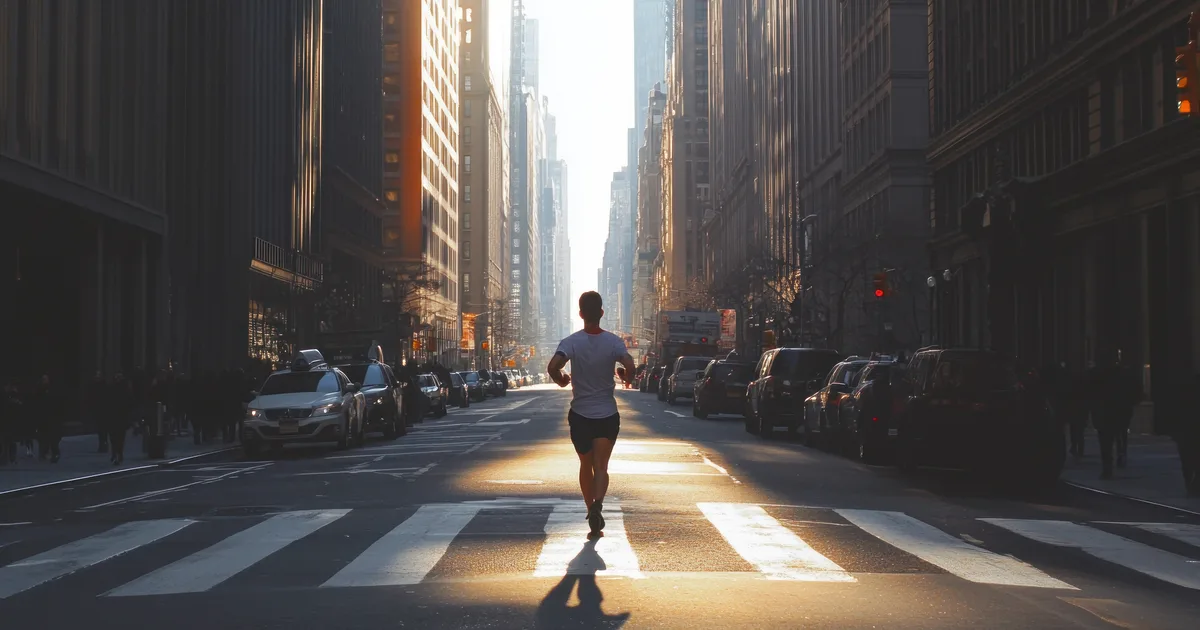
An analysis of more than 2.7 million results from six major marathons links nitrogen dioxide with slower times, especially among recreational runners. What it measures, what it does not prove and what you can decide, without turning it into an excuse to stay at home.
You have done the long runs, chosen your shoes and slept like a baby. But there is a rival at the start line who is not on the entry list: the air. An analysis of more than 2.7 million results from six major marathons links higher nitrogen dioxide with slower times, and the people it seems to weigh on most are not the elite. It is you.
What they measured
A team from the University of Leicester gathered 2,756,553 finishing times from Berlin, Boston, Chicago, London, New York and Tokyo, across editions from 2010 to 2024, and matched them with the estimated pollution for each race day, taking heat, wind and the trend over the years into account. The work was published in August 2026 in the journal Sports Medicine – Open.
The main character is nitrogen dioxide (NO₂), which at these races comes mostly from traffic. Each extra microgram per cubic metre was associated with 1.43 more minutes in men and 1.56 in women. Going from a day with little NO₂ to one with considerably more (from 5.2 to 10.3 µg/m³) was equivalent to about seven or eight minutes. Fine PM2.5 particles, on the other hand, showed no significant association.
What stands out is that these are modest levels. Most races were around or below the WHO daily guideline, which is 25 µg/m³ for NO₂, probably because they are held on weekend mornings with streets closed to traffic.
Why it affects you more than the elite
Among the elite, each microgram was associated with 0.34 minutes. Among recreational runners, with 2.12: about six times more. Part of the explanation is arithmetic, because you are out on the course for longer. Even so, expressed as a percentage of finishing time, the difference is still almost fourfold (0.18% against 0.67%).
The authors suggest several reasons, all still to be confirmed: more time breathing that air, less physical reserve, adaptations from intense training that may protect the elite, and the fact that recreational runners tend to prepare in the same city where they race. One curious detail: in men, the effect was greater between the ages of 18 and 29 (2.17 minutes) than from 60 onwards (1.32). The authors attribute this partly to the unusual fitness of people still running marathons at that age.
Before you hang up your trainers
The study is observational. The authors believe the relationship is probably causal, but this design does not prove it. Nobody measured what each person actually breathed: all the runners in a given edition were assigned the same value, estimated by an atmospheric model with a fairly coarse grid for the start location. Ozone was left out, and another large analysis of US marathons did find an effect from PM2.5, so that part is still under debate. The authors themselves also urge caution about extrapolating to other cities and levels.
Above all, this measures minutes at the finish, not health. A few minutes on the clock are no reason to stop going out, and even a small amount of running has been linked with living longer.
What you can decide
The study points towards adjusting your pace or training location on days when the air is worse. From there, these are our own suggestions, designed for your runs rather than for solving your city's problem. Getting up early is quite enough to be going on with.
Four decisions in your hands
- Check the air quality before a hard session, just as you check whether it is raining.
- Get away from traffic: NO₂ changes a lot over short distances, so a park or side street may be a better option than the main road.
- Avoid rush hour when you can. If your schedule allows, go out early at the weekend.
- If the air is heavy on race day, be flexible about your target pace and do not punish yourself over the clock.
For the first of those, Spain has its National Air Quality Index. And if it turns out to be a bad day, you can leave the intervals for another time and do an easy zone 2 run on a quiet route. If you have asthma or another respiratory or heart condition, ask your doctor what to do during these episodes.
Choosing where you run is also one of the advantages of not depending on a fixed course. The 21 km of the Artemis Challenge are added up at your own pace and from wherever you live, so you can do them in the park instead of along the main road. Your lungs will not thank you in writing, but the scenery is better too.

You already have your challenge.
All that's left is to start it.
Join this challenge and every workout gets you closer to your medal.
More from the Victoris Diary
 Entrenamiento
You run and lift weights: do they get in each other's way?
If you run or cycle and also lift weights, you may have been told that one steals from the other. A review of 17 meta-analyses puts that in perspective and helps you organise your week.
 Entrenamiento
Stretch for what it is good for: 20 experts’ guide, in minutes
A consensus of 20 researchers sets out what stretching is good for and at what dose: great for mobility, not much for preventing injury or recovering. We turn it into three routines with their minutes.
 Entrenamiento
What the UCI wants you to eat when you are off the bike
The Union Cycliste Internationale has published its position statement on nutrition. Beyond what is in your jersey pockets: eating enough, looking after your bones and which supplements are genuinely backed by evidence.