
Riding outside beats the turbo: 87 studies say so
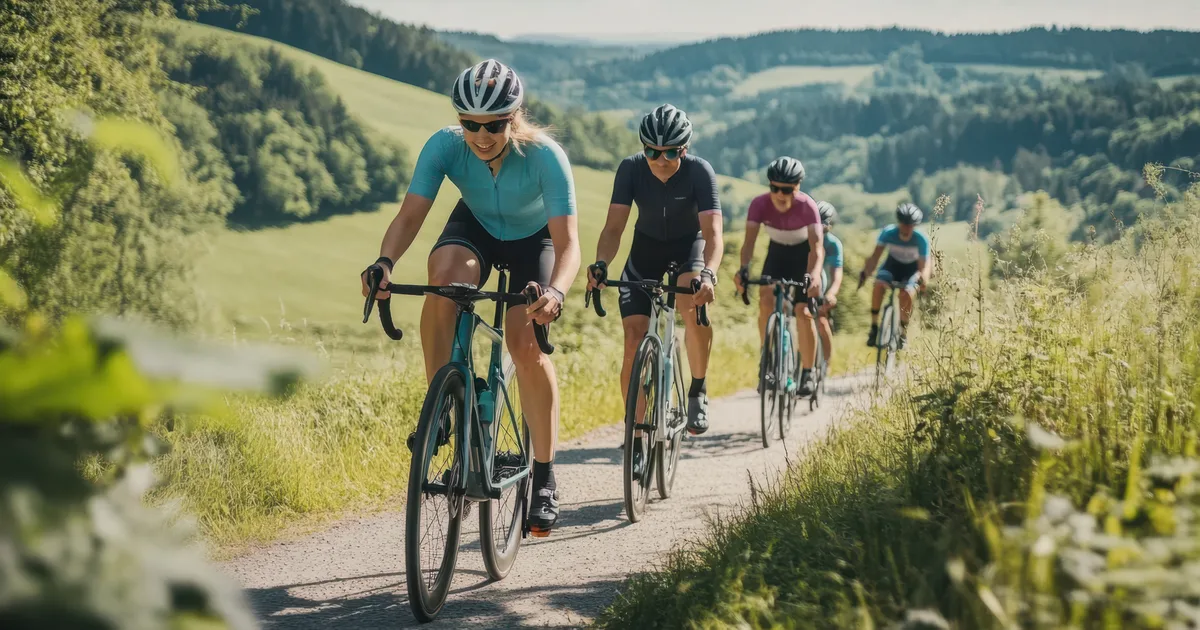
A review of 87 studies across 19 countries finds something the turbo trainer in your living room will not enjoy: 100% of outdoor interventions improved mood, against 35% of indoor ones.
That cycling feels good is not news. It gets interesting when someone bothers to pool 87 studies from 19 countries and ask under exactly which conditions it feels good. Because it turns out that pedalling on the road is not the same as pedalling in the living room, and that one stray Sunday ride is not the same as every Sunday. The gaps are not subtle.
Outdoors, 100%; indoors, 35%
The review, published on 19 May 2026, gathered interventions of every kind: school programmes, group rides, stationary bikes and daily commutes. This is the number that carries the article: 100% of outdoor interventions improved participants' affective wellbeing, while indoor ones managed it in only 35% of cases.
Sit with that for a second. Same movement, same legs, same energy cost. What changes is the scenery, the light, the air and the fact of being out in the world rather than facing a wall. The turbo trainer builds your legs just as well; what it cannot reproduce is outside.
One ride is not a programme
The second finding points the same way, and it points at consistency. Programmes sustained over time produced positive psychological wellbeing results in 77% of cases. Single-session interventions managed 33%. Which is to say: the epic August ride is excellent for the photographs, but what moves the needle is the unremarkable ride you repeat.
It is exactly the argument behind planning your season like a cyclist so you do not quit halfway, and the reason an eight-week progressive plan works better than three heroic outings and a month on the sofa. The review is not saying this to sell you a plan: it falls out of the data.
And the social side, which almost nobody measures
One finding stands out for how absolute it is: in every single study that bothered to measure social wellbeing, cycling came out ahead. Every one. The cognitive picture was favourable too, with reported improvements in attention, memory and mental flexibility.
With one caveat worth pocketing: moderate intensity suits mental performance best, while very hard efforts can temporarily worsen it. So if you head out to clear your head before a difficult afternoon, going full gas may be counterproductive. Riding easy is not cheating.
How to use this on Sunday
- If you have the choice, take the road: the turbo is plan B, not plan A.
- Favour frequency over epics: four short rides beat one brutal one.
- Ride with other people if you can. It was the only thing positive across every study.
- To clear your head, keep it moderate; save the hard stuff for training days.
- The commute counts too: it sits squarely inside what the review analysed.
The small print, because there always is some
This is a scoping review, not a clinical trial: it maps what has been studied, it does not prove causes. And the authors flag their own gaps. Most of the work was done indoors in laboratories — precisely the condition that performed worst — so the indoor-versus-outdoor comparison rests on uneven samples. On top of that, only 5% of studies reported participants' ethnicity and barely 2% included non-binary participants.
None of that topples the conclusion, but it does place it properly: a clear, consistent signal, not a law of physics.
Outdoor interventions and repeated programmes showed the most consistent positive impact.
Frontiers in Sports and Active Living, May 2026
Making consistency visible
The trouble with consistency is that you cannot see it until much later. Which is why a counter in front of you helps: the Poseidon Challenge is completed with 100 accumulated kilometres, no deadline, adding up whatever you do each day. The twenty-minute run to the shops counts. Saturday morning counts. And suddenly those unremarkable rides that science says are the ones that matter have something to show at the end.

You already have your challenge.
All that's left is to start it.
Join this challenge and every workout gets you closer to your medal.
More from the Victoris Diary
 Entrenamiento
Stretch for what it is good for: 20 experts’ guide, in minutes
A consensus of 20 researchers sets out what stretching is good for and at what dose: great for mobility, not much for preventing injury or recovering. We turn it into three routines with their minutes.
 Entrenamiento
What the UCI wants you to eat when you are off the bike
The Union Cycliste Internationale has published its position statement on nutrition. Beyond what is in your jersey pockets: eating enough, looking after your bones and which supplements are genuinely backed by evidence.
 Entrenamiento
Helmet, lights and 1.5 metres: your bike and October’s new rules
Spain’s reformed road traffic regulations come into force on 1 October: helmets for every cyclist outside towns, new rules in the city and a checklist for your first autumn ride.