
Your watch says you slept badly (and you believe it)
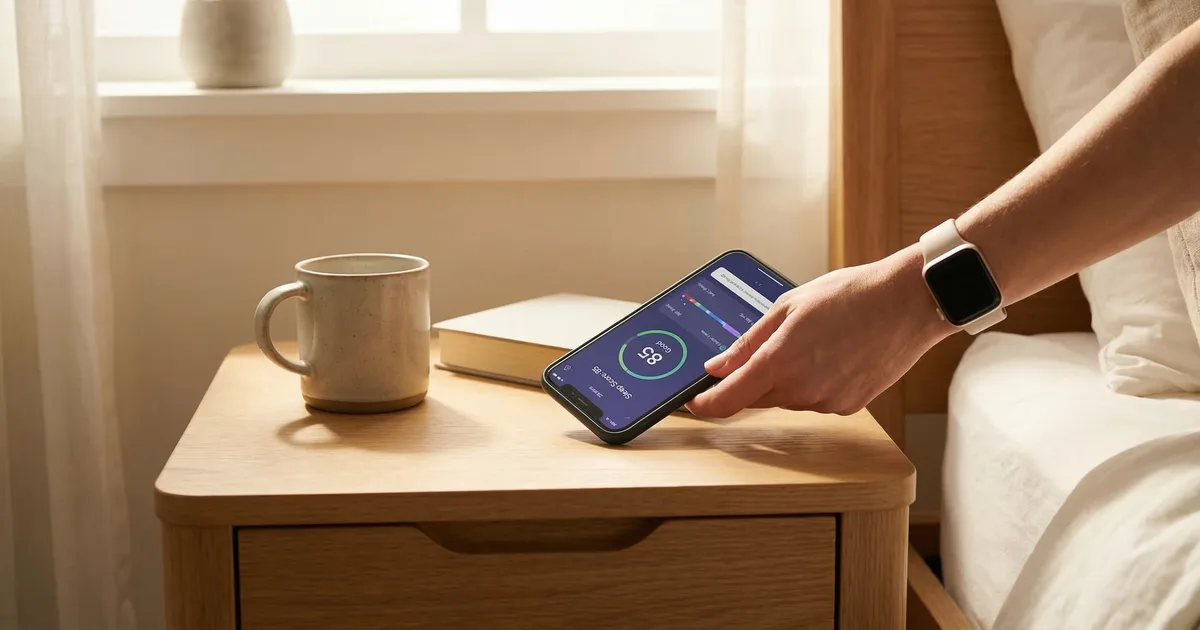
A survey by the American Academy of Sleep Medicine captures the craze for tracking sleep and its flip side: anxiety about sleeping well. Which data deserve your attention if you train, and which are best ignored.
You wake up, you feel reasonably fine, you glance at your watch and… 62 out of 100. «Poor sleep». Suddenly your legs feel heavy, the coffee is not working and this evening's session seems like a terrible idea. Did you sleep badly, or did a wristband tell you so? Sometimes, surprise surprise, it is the latter.
Sleep tracking is in fashion (very much so)
The American Academy of Sleep Medicine (AASM), the leading scientific society in the field in the United States, commissioned a survey of 2,007 adults in that country in June 2025 and published the results in January 2026. Some 48% have used a device to track their sleep —a watch, a ring, an app—, up from 35% in 2023. And it is not mere curiosity: 55% admit to having changed a habit because of what the device told them.
So far, good news. Taking an interest in your rest is great, especially if you train: sleep is the part of the plan that never appears in the calendar but holds everything up. The trend even has a name on social media, sleepmaxxing, which essentially means squeezing every minute of sleep through gadgets, routines and products. The survey also measures the spending: 20% of men and 12% of women have spent between 200 and 500 dollars on sleep products, not counting mattresses.
The flip side: losing sleep over sleep
The most striking figure is another one: 76% of respondents say they have lost sleep worrying about their sleep problems. This is known as sleep anxiety or orthosomnia: the obsession with sleeping «perfectly» that, paradoxically, ends up costing you hours in bed. Mind you, the figure refers to all adults and not only to those who wear a tracker, so do not put all the blame on the watch. But a gadget that marks you every morning does not exactly help you relax either.
It is important that tracking enhances sleep and does not cause more stress about it.
Shalini Paruthi, AASM spokesperson
The academy adds a sensible piece of advice: if you find yourself tossing and turning, worrying about how you will sleep, it may be time to step back and see a health professional.
The three data points that do deserve your attention
The AASM suggests focusing on what matters: total sleep time, consistent sleep and wake times, and night-time awakenings. Applied to someone who trains, it looks like this:
Look at this (in the morning, not at three a.m.)
- Total sleep time, as a trend: not a single night but the weekly average. Anyone can have a bad night; five in a row is a signal.
- Regularity: whether you go to bed and get up at similar times, weekends included.
- Awakenings: if they keep happening night after night, it is worth asking why (late dinner, screens, very late training, stress).
And three more tips from the academy: wear the device consistently so the baseline is reliable, make small changes one at a time to see what works for you, and check the data only in the morning, without getting hooked on the screen.
What you can leave alone
The overall daily score, the percentages for each sleep stage and the dramatic alerts. It is not that they are useless; it is that they should not count for more than how you feel. Remember, too, that these are consumer devices: the AASM points out that they cannot diagnose or treat sleep disorders. If you suspect you have one (snoring with pauses, insomnia that will not go away, sleepiness you cannot explain), that is a job for your doctor, not the app.
And what if the watch is right?
It happens. Then the useful question is not «what is my score» but «how do I feel». If you really have had a very short night, here is what to do with your training after four hours' sleep. And if what you want is to sleep better in the long run, moving during the day helps, and for that there is a walking plan to sleep better that needs no gadget at all.
Your pact with the watch
- You check it in the morning, once, and get on with your day.
- If you feel fine and the score is poor, how you feel wins.
- If the score is keeping you awake, take the tracker off for a few nights. Nothing bad will happen.
- If you have been sleeping badly for weeks, see a professional.
In the end, the best indicator is still the oldest one: waking up wanting to get on with things. And that one needs no battery.
Turn those kilometres
into a medal.
Sign up for a Victoris challenge and every training session brings you closer to the medal delivered to your door.
More from the Victoris Diary
 Vida saludable
Creatine after 45: what the study says (and what it does not)
A Texas A&M study in people aged 45 to 65 suggests creatine helps build muscle and strength even without training. We go through the results, the small print and what to check before buying a tub.
 Vida saludable
Walk your way to better sleep: your 25-week plan, step by step
A meta-analysis of 200 trials places walking among the exercises that most improve sleep, especially if you sleep badly now. Here is a phased plan, with honesty about what science does not yet know.
 Vida saludable
The exercise you choose protects your brain (work, not so much)
A meta-analysis of more than 4 million people links leisure-time exercise to a 24% lower risk of dementia, but not physical activity at work. Here is why chosen movement makes the difference.