
Carbs on the move: how many grams per hour you really need
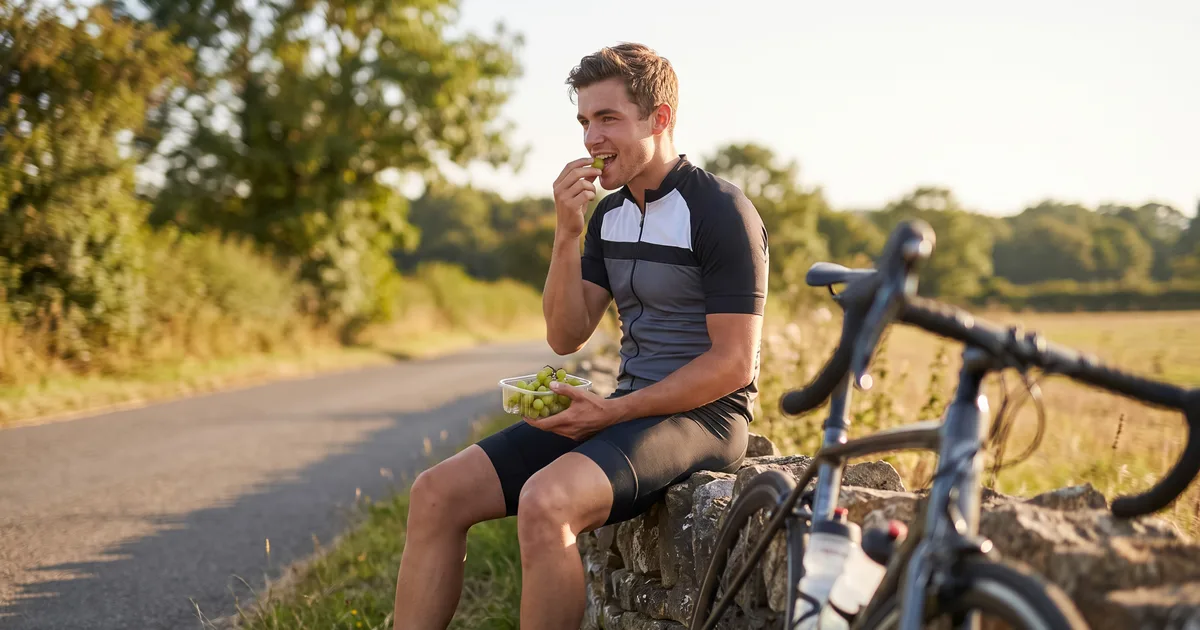
A 2026 review raises the ceiling to 120 g of carbs per hour. Before you down four gels, here is what applies to amateurs and how to turn it into bananas, dates or a homemade drink.
If you have been on social media lately, you will have seen professionals putting away 120 grams of carbohydrate an hour as casually as a bag of crisps. A scientific review published this year backs that figure… for the people who actually need it. The good news: if you are preparing for a sportive or an autumn half marathon, you can perform brilliantly on rather less, without turning your stomach into a cement mixer.
What the review proposes (and for whom)
A team from Liverpool John Moores University, led by Morton and colleagues, has reviewed in The Journal of Nutrition what we know about carbohydrate during endurance exercise. They propose moving the classic ceiling of 90 g per hour to a range of 90-120 g, with two very clear conditions: trained athletes and events lasting more than 2.5-3 hours. They also remind us of something anyone who has overdone the gels knows first-hand: high doses bring more gut trouble.
One detail worth knowing: several of the authors declare links with a sports nutrition brand (Science in Sport). That does not invalidate the review, but it is a good reason to read the 120 g with a critical eye rather than as an order.
Your figure depends on how long the event lasts
For amateur athletes, the consensus guidelines that have worked for years remain the best starting point. They are only a guide: your weight, your pace and your stomach have the final say.
Grams of carbohydrate per hour, as a rough guide
- Under 1 hour: you do not need to eat anything; water and enjoy it.
- 1 to 2 hours: up to about 30 g per hour, especially if you are pushing the pace.
- 2 to 2.5 hours (an easy half marathon, a long ride): between 30 and 60 g per hour.
- Over 2.5 hours (marathon, sportive): 60 to 90 g per hour, mixing glucose and fructose sources for better absorption.
- Above 90 g: territory for very well-trained people with very well-trained stomachs. Not the place to start.
And no, this does not contradict those who eat few carbs day to day: if you are curious, we went through what the Spanish Nutrition Society consensus says about keto, fasting and low-carb. Today is about what you eat while moving for hours, which is a different story.
From grams to real food
Nobody heads out with kitchen scales in their jersey pocket, so let us translate. Amounts are approximate (check the label where there is one):
Around 20-30 g of carbohydrate is roughly…
- A medium banana: about 25 g.
- A large Medjool date: about 18 g; two small regular ones, a bit less.
- A 50 g portion of quince paste (membrillo): about 30 g, and very Spanish.
- A handful of raisins (30 g): about 20 g.
- A gel: between 20 and 30 g, depending on the brand.
- Homemade drink: 500 ml of water, 30 g of sugar (about two and a half tablespoons) and a pinch of salt. Around 30 g per bottle.
A practical example: for a five-hour sportive aiming at 60 g per hour, one bottle of homemade drink every hour plus a medium banana, or a large date and a handful of raisins, would do the job. For a half marathon of two hours and a quarter, aiming at about 30 g per hour, one gel every 40 minutes from the first third of the race is enough.
Your stomach can be trained too
The message repeated most often in the research is that tolerance to eating on the move improves with practice. The gut adapts, but you have to ask it nicely and give it time, not on race day.
A 4-week gut training plan
- Week 1: on your long run or ride, take about 30 g per hour from the first third.
- Week 2: go up to 40-45 g per hour with the same foods.
- Week 3: try 50-60 g and mix sources (banana plus drink, for example).
- Week 4: rehearse exactly what you will take on the day, at race pace.
- If you get wind, bloating or nausea, go back a step for another week.
- The golden rule: nothing new on race day. Not even that mango-flavoured gel from the goody bag.
If you also use caffeine, remember it needs testing in training too: here we explain the coffee dose that actually works before training, because combining it with lots of gels can be too much for some stomachs.
Your autumn, with a full tank
If you are aiming for your first half marathon this autumn, the Artemis Challenge is exactly 21 km, and a great way to clock up long runs where you can rehearse your fuelling strategy. Reaching the finish full of energy, without visiting every portable toilet on the course, is also a victory.
Turn those kilometres
into a medal.
Sign up for a Victoris challenge and every training session brings you closer to the medal delivered to your door.
More from the Victoris Diary
 Vida saludable
Batch cooking for people who train: the one-afternoon plan
One Sunday afternoon, real quantities and the Harvard storage times so Thursday is not a gamble. A batch cooking plan built for weeks with training in them, with a shopping list and the exact order to cook things in.
 Vida saludable
The WHO 150 minutes are not the target: they are the floor
The WHO estimates that 1.8 billion adults fall short of the minimum for physical activity. We unpack the full recommendation, the one hardly anyone reads, and spread it across a real September week with work, kids and no time.
 Vida saludable
Move, sleep, stand up: the trio that looks after your brain
A PLOS ONE meta-analysis looks at three things we usually keep in separate boxes: how much you move, how much you sleep and how many hours you spend sitting down. All three show up in the picture, and hardly anyone keeps an eye on the third.