
Batch cooking for people who train: the one-afternoon plan
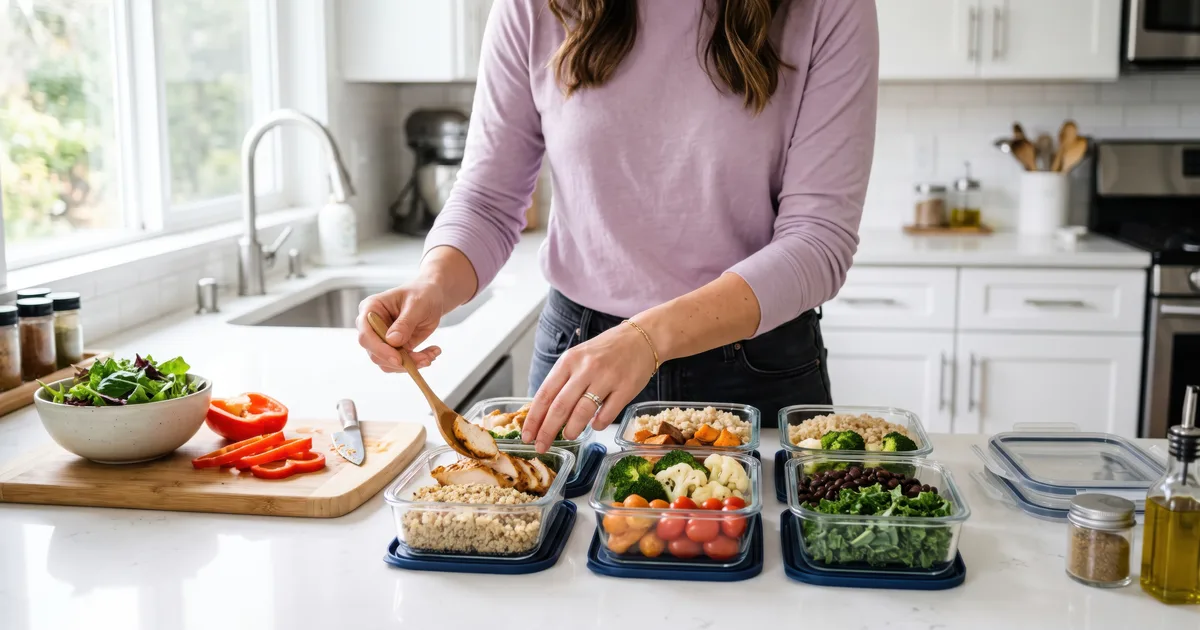
One Sunday afternoon, real quantities and the Harvard storage times so Thursday is not a gamble. A batch cooking plan built for weeks with training in them, with a shopping list and the exact order to cook things in.
The week where you train three days and work five has one weak point, and it is not the gym: it is nine o clock on Wednesday evening, hungry, tired, with the fridge looking back at you blankly. The Harvard T.H. Chan School of Public Health has a batch cooking guide aimed at exactly this, and we have turned it into a one-afternoon plan with quantities, timings and the part nobody talks about: how not to end up binning half the fridge.
The rule that changes everything: cook bases, not dishes
The classic mistake of the ambitious Sunday is making five identical tubs of stew. By Tuesday you never want to see it again. The Harvard guide suggests the opposite: spend the effort on what takes longest, proteins, wholegrains, dried pulses and roasted vegetables, and then build each dinner in five minutes by combining those bases differently.
The same brown rice is a bowl with chicken and vegetables on Monday, a stir-fry with an egg on Wednesday and the side to a piece of fish on Friday. You cook once, you eat different things, and your post-training meal stops being improvised, which is usually where recovering on whatever you can grab first starts to go wrong.
The shopping list (2 people, 4 dinners and 2 post-training meals)
What to buy
- 300 g uncooked brown rice (or quinoa, if you have less patience: it takes half the time).
- 500 g chicken, breast or boned thigh.
- 2 tins of cooked chickpeas, 400 g drained each, or 250 g dried chickpeas soaked overnight.
- 1 kg of vegetables for roasting: courgette, red pepper, onion and sweet potato work well together.
- 8 eggs.
- 1 bag of spinach or lamb lettuce, added raw at the end and never cooked.
- Extra virgin olive oil, lemon, paprika, cumin and whatever else is in the cupboard.
The order of the afternoon: two hours and no dead time
The trick is overlapping, not doing things one at a time. Heat the oven to 200 °C and put in the tray of chopped vegetables with oil and salt: they need 35 to 40 minutes and no supervision. While it heats, get the brown rice on, which takes roughly the same.
With those two fronts running, boil the eggs: ten or eleven minutes from the boil, then straight into a bowl of cold water, which makes them far easier to peel. Then the chicken: either pan-fried in batches, or on a second oven tray with paprika, making use of heat you have already paid for. And the chickpeas, if they are tinned, just need draining and rinsing.
Once everything is lukewarm, never put anything hot in the fridge, it raises the temperature of everything else, divide it into containers by type of food, not by meal. And label them with the date, even if it feels like something a restaurant would do. In forty-eight hours you will not remember which one was Sunday.
How long each thing keeps (according to Harvard)
This is the part that makes batch cooking safe rather than a lottery. With the fridge at 4 °C or below:
In the fridge
- 1 to 2 days: cooked minced meat or minced chicken.
- 3 to 4 days: cooked whole meats, fish and chicken; soups and stews.
- 5 days: cooked pulses and hummus.
- 1 week: hard-boiled eggs and chopped vegetables in an airtight container.
- 2 weeks: opened soft cheese.
- 5 to 6 weeks: opened hard cheese.
And in the freezer, at -18 °C or below: soups, stews and cooked pulses keep for 2 to 3 months; cooked or minced meat and chicken, 3 to 6 months; berries and chopped fruit, 6 to 8 months; and vegetables blanched before freezing, 3 to 5 minutes in boiling water, reach 8 to 12 months.
How not to bin half the fridge on Thursday
Look at that list again and order your week accordingly: if you made something with minced meat, that is Monday dinner, not Thursday. Cooked whole chicken will comfortably see you to Wednesday. And the Thursday portion, if you cooked it on Sunday, goes into the freezer on Sunday, not on Wednesday when it has only hours left in it.
Harvard also insists on starting small: two or three dinners in the first week, not a month of meals. People who give up on batch cooking almost never give up because of the food, they give up because they built themselves a six-hour Sunday they would never repeat.
A couple of tricks for training weeks
If you run or ride in the evening, prepare the liquid part separately: it is far easier to have something the moment you walk in and eat properly half an hour later than to fight with a frying pan on heavy legs. Our homemade post-training shakes with quantities slot straight into this system and take about as long as getting your trainers off.
And if you would rather not cook the protein that far ahead, the guide offers a very practical alternative: marinate it in the fridge on Sunday and cook it on the night. Five minutes in the pan, zero decisions to make while hungry. Because decisions made while hungry, as you well know, have never been the finest of your life.
Turn those kilometres
into a medal.
Sign up for a Victoris challenge and every training session brings you closer to the medal delivered to your door.
More from the Victoris Diary
 Vida saludable
Creatine after 45: what the study says (and what it does not)
A Texas A&M study in people aged 45 to 65 suggests creatine helps build muscle and strength even without training. We go through the results, the small print and what to check before buying a tub.
 Vida saludable
Walk your way to better sleep: your 25-week plan, step by step
A meta-analysis of 200 trials places walking among the exercises that most improve sleep, especially if you sleep badly now. Here is a phased plan, with honesty about what science does not yet know.
 Vida saludable
The exercise you choose protects your brain (work, not so much)
A meta-analysis of more than 4 million people links leisure-time exercise to a 24% lower risk of dementia, but not physical activity at work. Here is why chosen movement makes the difference.